Seedream 5.0 Flash for manga: why we chose it for Konyomi
Our Seedream 5.0 Flash review: early manga portrait comparisons, response times, estimated costs and lessons from character reference tests.
A character portrait can look beautiful and still create problems for a manga. A weapon appears that the script never mentioned. An outfit changes between views. The next image takes long enough that checking another variation becomes a chore.
Our choice for Konyomi
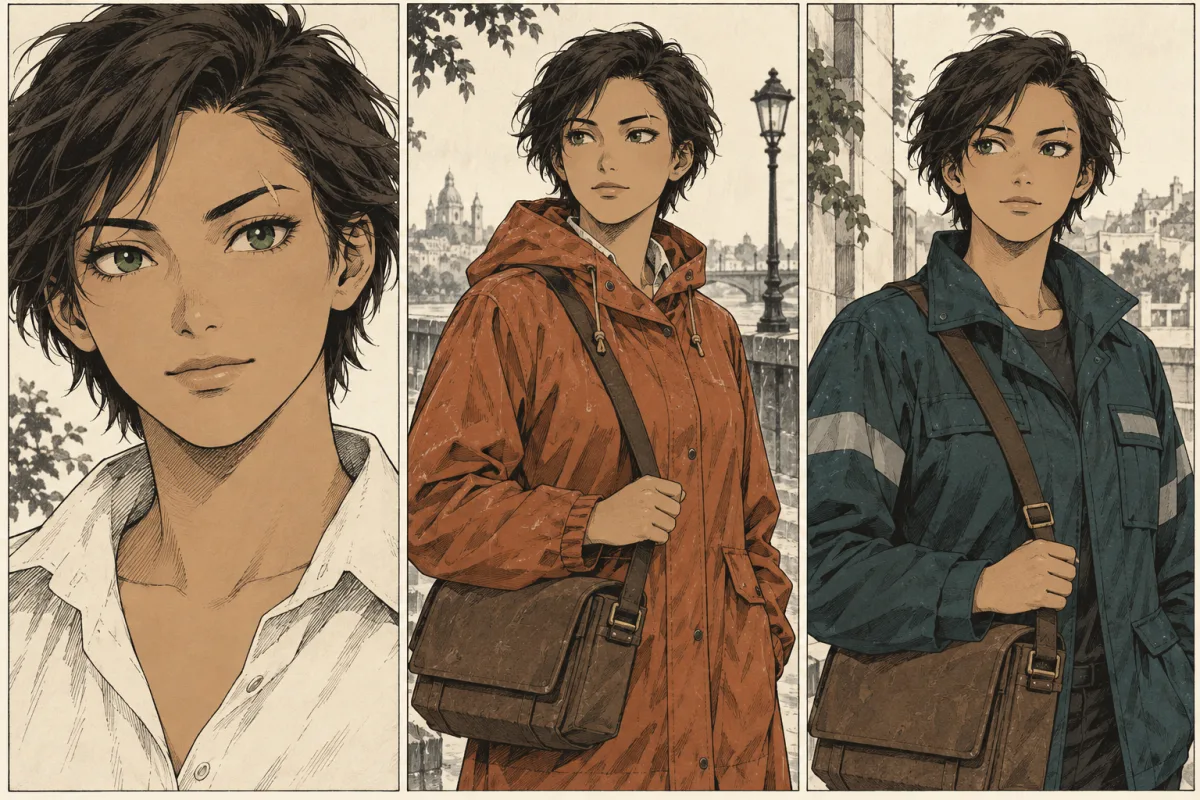
Those are the kinds of problems we encountered while building Konyomi. We selected Seedream 5.0 Flash as our image model after early experiments with several alternatives. Its sharp manga inking, short response times and low estimated image cost made it a practical choice for continued development.
Our later tests also exposed mistakes worth understanding before using it for a story.
The portrait test that informed our choice
On October 3, 2026, we compared several image models through OpenRouter. Each model received four character portrait requests in a shonen treatment, using the same prepared character descriptions and concept prompt. These requests used text alone. Reference-image tests came later.
Here is the most useful part of our recorded comparison:
| Model | Observed generation time | Estimated price per image at the time | What we noticed |
|---|---|---|---|
| Seedream 5.0 Flash | 12–20 seconds | About $0.02 | Sharp inking and original character designs |
| FLUX 3 Image | 30–45 seconds | About $0.02 | Clean shonen line work and original designs |
| Gemini 3.1 Flash Image | About 9 seconds | About $0.08 | Polished results with the strongest reliability noted in this small sample |
| Seedream 5.0 Pro | 60–80 seconds | About $0.04 | Added details beyond the supplied description |
The source was a short fan-fiction passage, which matters when judging originality. GPT Image 2 produced the highest finish in our notes, but its designs resembled the source franchise. That observation needs an original-story retest before drawing a broader conclusion about the model.
FLUX 2 Pro and Max produced good results, although some prompts encountered moderation blocks. The cheaper FLUX 2 Klein 4B had the weakest visual quality in this comparison.
This was an early development test with a small sample. The times were observed waits, and the prices were estimates rather than measured billing. We had no blind scoring or repeated trials. These results helped us choose a model to work with; they cannot establish performance across every manga style or complete chapter.
Short waits make visual iteration easier
Seedream Flash gave us useful manga line work within roughly 12–20 seconds in that test. FLUX 3 took about 30–45 seconds at a similar estimated image price.
That difference matters during character design. You might need to check whether a collar obscures a neck marking, whether a silhouette reads clearly, or whether an expression suits the scene. Every revision involves another wait and another image to inspect.
Gemini Flash Image was faster in our sample and produced polished results. Its estimated price was also higher. Seedream offered a workable balance for a process that needs frequent visual checks.
OpenRouter currently lists Seedream Flash from $0.018 per image, checked October 6, 2026. Published prices can change. A useful cost comparison should also count how many attempts you need before accepting an image.
A good portrait still needs a good reference view
Manga asks you to recognize the same character from another angle, in another expression and eventually in another scene.
After selecting Seedream, we tested reference-image input. In one painterly back view, the model preserved the concept's coat, hair, lantern, pail and boots. The image contained no unwanted lettering. That was a useful result because several specific design choices survived the change in view.
Later shonen results were mixed. Some preserved important character traits. One reference added a straight sword absent from the concept. A creature described as wolf-like stood on two legs, and another view changed its color and head shape.
A reference image gives the model visual information to work from. You still need to compare the output with the approved design and the scene's requirements. Inspect equipment as carefully as the face.
Better descriptions changed the results too
Some of our image problems began before the image request.
A story can describe a character in hospital clothing, then armor, then carrying a weapon. Combining those details into one appearance description gives the model conflicting instructions. We encountered this while trying to establish a character's earlier look.
We separated lasting identity traits from the outfit for a particular scene. A later concept showed the expected white hair, amber eyes and red neck markings with hospital clothing. The earlier tactical clothing and sword were absent.
That improvement came from changing the information supplied to the model. It would be misleading to attribute every difference between those runs to image-model quality.
If you are comparing models yourself, keep the character description, outfit, camera instruction and art treatment fixed. Save the exact prompt beside each output. Changing several instructions at once makes the comparison harder to interpret.
Judge the images you can use in your story
For a manga project, keep a record of accepted images and rejected attempts. Write down the reason for each rejection: wrong outfit, missing mark, invented equipment, incorrect anatomy or an unreadable composition.
Then compare the money and time spent reaching an acceptable result. A low price per image is useful, but repeated corrections can consume that saving. A highly finished portrait may also need more work if it contradicts the story.
Our next useful comparison would cover original characters, reference-based views and scenes with more than one character. Page composition needs its own test. Four portraits cannot tell us how well a model will handle a dialogue-heavy page.
Seedream Flash remains our selected model for development and production configuration. Konyomi's public manga creation is still in early access. The observations here describe development experiments, including the failures we still need to address.
Before drawing your cast, use the free character continuity sheet to record lasting traits and scene-specific outfits. Our character consistency guide explains the preparation changes that helped us inspect and improve those results.
Sources
Konyomi turns a written story into manga. It opens soon.